How New Years Resolutions Can Work Psycology Today
Are New Year's resolutions powerful or pointless?
(Epitome credit:
Getty Images
)

1 January may seem like an arbitrary appointment to start self-improvement, but there are practiced psychological reasons for doing so.
A
Most every year of my adult life, I've started the New year's day with a set of resolutions that I've been adamant to keep. The results, predictably, take been variable.
In 2021, I more often than not kept to my fitness goal of doing i 20-infinitesimal HIIT workout each day, but I failed miserably at my aim of quitting social media. According to my weekly screen-time reports, I still spend betwixt 2 and 3 hours each day on my phone, much of that fourth dimension doomscrolling.
I am far from alone in my decision to start each new twelvemonth with a programme for self-improvement. At to the lowest degree a quarter of people typically brand at least one New year's day'due south resolution, and a large portion of those skillful intentions terminate in disappointment.
For those who don't follow this tradition, the very act of creating a New year's day's resolution tin can seem illogical. Rationally speaking, 1 January should exist no amend than any other 24-hour interval to make a life change – then why put the needless pressure on ourselves to 'upgrade' our lives at the opening of a new agenda?
Contempo psychological research, however, suggests that there are many good reasons to begin a new regime on the commencement twenty-four hour period of a new year. And past understanding and capitalising on those mechanisms, we can all increase our chances of sticking to our new goals for 2022.
The fresh-start event
It'south hard to pinpoint exactly when our tradition of making New Year's Resolutions was first established. Anna Katharina Schaffner, a cultural historian and writer of The Fine art of Self-Improvement, notes literary references to self-improvement go back centuries, to Chinese antiquity and the Roman Stoics, for example. The practice of pegging goals to a particular calendar date was already well-established past the 1860s, as seen in one of Mark Twain'southward letters.
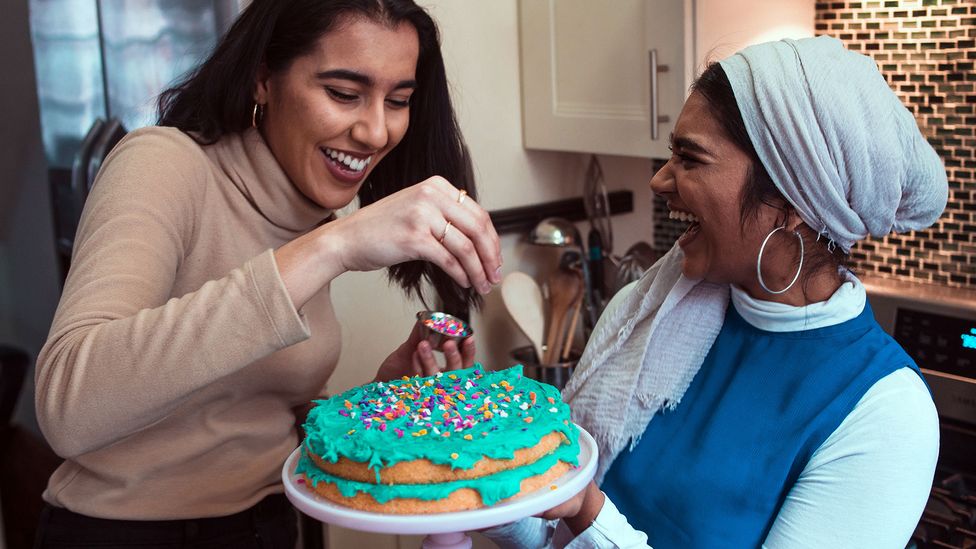
Whether your goal is to spend more than time with family unit or make it onto the Bake Off, using the New Year as a mark tin can help you lot reach your objectives (Credit: Getty Image)
"Yesterday, everybody smoked his last cigar, took his terminal drink, and swore his final adjuration," he wrote on i January 1863. "Today, we are a pious and exemplary customs. Xxx days from now, we shall take cast our reformation to the winds and gone to cutting our ancient shortcomings considerably shorter than e'er. We shall also reverberate pleasantly upon how we did the same old thing terminal yr near this fourth dimension."
In Schaffner'south opinion, it is no coincidence many of us are especially keen to make positive changes after a hedonic holiday season. "Y'all take over indulged and now it's time to purify," she says. It's notable, she says, that many resolutions are focused on forbearance – giving up our bad habits to cleanse our bodies and our souls.
The "purity principle" tin't fully explain our penchant for New year's resolutions. Many of us, after all, may make promises after relatively sober festivities. And many of our goals are related to work or personal pursuits that have naught to do with spiritual and physical atonement. So, is there something special virtually the date itself that makes personal alter, of any kind, enticing?
Some clues come from the style the brain organises its memories. Psychologists accept institute that, rather than seeing our life as a continuum, nosotros tend to craft a narrative, divided into dissever "chapters" that mark the unlike stages of our life. "People tend to think nigh life every bit if they're characters in a book," says Katy Milkman, a psychology professor at The Wharton Schoolhouse of the University of Pennsylvania, and the writer of the book How to Change.
Those chapters may characterise major life events – such as arriving at university, getting married or the birth of your commencement child. But your mind tin also split those major capacity into smaller sections so that the start of a new twelvemonth tin represent a break in the narrative. "Whatever time yous accept a moment that feels like a partitioning of time, your mind does a special affair where information technology creates a sense that you accept a fresh kickoff," says Milkman. "You're turning the folio, yous have a make clean slate, it'due south a new beginning."
This helps you to create psychological distance from by failures, she says, allowing you to feel that any mistake was the "old you" and that you'll at present practise better. On 1 January, I can retrieve that all my fourth dimension-wasting on Twitter was "2021 David", while "2022 David" is going to have the focus and dedication of Zadie Smith, who somehow shuns social media (and indeed whatsoever online distraction) as she writes her masterpieces.
Milkman has worked with Jason Riis, at Harvard University, and her doctoral educatee Hengchen Dai, now a professor in UCLA'southward school of management, to investigate the "fresh-start effect" in various settings. In 1 written report, they analysed information from stickK, a popular goal-setting website and app that is meant to help people with their self-improvement. Dai and Milkman found that people were not only probable to prepare new goals at New year – as y'all might expect – but as well subsequently whatever holiday breaks. There was even a slight uptick on Mondays, as people try to reset with the get-go of the new week, and on the first solar day of each month.
As further evidence, Milkman, Riis and Dai tested whether they could prime the fresh start effect artificially. To exercise so, the researchers beginning invited participants to sign-up for an email reminder of their goals – with subtle differences in the way they framed the date. Consider one reminder, sent on 20 March. For some students, the date was simply labelled "the third Th in March" – inappreciably a meaning landmark. For others, it was called "the start day of jump" – which they hoped would provoke the sense of a new start.

Instead of saying y'all'll 'cook good for you' this yr, look at your goal some other style – say y'all'd similar to eat more fresh veg each mean solar day (Credit: Getty Images)
Information technology worked a treat. The students who had been encouraged to think of a "fresh outset", based effectually a temporal landmark, were more probable to start a new gym habit, improve their sleep hygiene or spend less time on social media – compared to those who had non been primed to meet the date as a marked and pregnant division in the timeline.
The New year's day, of course, is an particularly compelling starting bespeak, compared to those other events. "It is a big affiliate break for most people," says Milkman.
From failure to success
Sceptics may however wonder whether the do is worthwhile. Surely, near people are only setting themselves up for failure – no? Yet the bachelor data shows that the overall success rate is college than many might think.
According to a recent YouGov survey, 35% of people who fabricated resolutions managed to stick to all of their goals, and 50% of people managed to keep some of their resolutions. That's a lot of people who are making at least some positive changes to their lives – even if they do also neglect at some of their goals.
The way you frame your resolutions could brand an of import difference. Per Carlbring at Stockholm University recently tracked the progress of ane,066 people who fabricated New Year'due south Resolutions at the finish of 2017. He categorised their intentions into ii classes. Some were "avoidance goals" – which, every bit the name suggests, involved quitting something like sweets, alcohol or social media. The others were "approach goals" – which involved adopting a new habit – such as swimming twice a week or practising the guitar in the evening. On average, the participants were about 25% more likely to see their arroyo goals than the avoidance goals. "Instead of stopping things, yous should start doing things," he concludes.
I can easily see how this effect played out in my ain resolutions for 2021. I by and large kept my resolution of completing a HIIT workout each day (an approach goal) but failed miserably at my attempt to quit social media (an abstention goal).
Fortunately, Carlbring says nosotros can often turn an avoidance goal into an arroyo goal to maximise our chances of success. Supposing you want to lose weight. "Instead of saying that I desire to cease eating a processed bar every twenty-four hour period, I might instead say that I want to offset eating carrots each afternoon," he says. "Considering that would increase your blood-carbohydrate level, and yous then wouldn't accept the craving for something else."
Similarly, if I want to reduce my social media employ, I might set myself the goal of reading 10 pages of an ebook whenever I am ready for a chip of reanimation or distraction on my phone – a productive activity that should, I hope, lure me away from my usual doomscrolling.
Y'all'll even so demand perseverance, of course – merely Milkman and Carlbring both argue that we should be forgiving of the odd failure. "If yous confront a setback, then you might think that yous volition never be able to achieve your goal," Carlbring says. "Only yous can try to view it as a lesson to be learned."
If you lot face a serious blockage, you lot can always endeavor to look for another milestone that might marking a new beginning. If y'all've started to founder in Feb, for example, you might make a new delivery to first again at the beginning of March – a small act of reframing that should requite you the boost of the fresh-start effect all over over again.
Whatever journeying worth pursuing will include a few bumps along the way – but by understanding the psychology of personal modify, you can vastly increase your chances of reaching the goal.
David Robson is a science writer and writer based in London, UK. His adjacent volume, The Expectation Outcome: How Your Mindset Can Transform Your Life will be published in the U.k. on 6 January and in the US on 15 February 2022. He is @d_a_robson on Twitter.
Source: https://www.bbc.com/worklife/article/20220103-powerful-effective-new-years-resolutions

Post a Comment for "How New Years Resolutions Can Work Psycology Today"